
How to Integrate a Consent Management Platform with Your Website
Execute a seamless CMP integration on your website. Follow our step-by-step setup guide for DPDP compliance, auto script blocking, and ConsentiQo sync.

Deploying a privacy banner on your homepage isn’t enough to meet today’s data protection laws. India’s Digital Personal Data Protection (DPDP) Act and other global privacy rules require websites to collect detailed, purpose-specific opt-ins, block unauthorized trackers until users approve them, and update revocation requests across all connected tools instantly. Proper CMP integration is what separates basic compliance from a truly audit-ready privacy setup.
Whether you have a WordPress marketing site, a custom React app, or a busy e-commerce store, integrating a Consent Management Platform requires careful planning across your frontend scripts, tag managers, and backend databases.
What Is Website CMP Integration and Why Does It Matter?
A Consent Management Platform integration connects consent-capturing software directly to your website’s code, tag management systems, and downstream marketing or analytics tools. Instead of merely displaying a static pop-up, an integrated CMP acts as an active gatekeeper:
Prior Script Blocking: It prevents third-party pixels, analytics cookies, and advertising SDKs from firing until the visitor explicitly opts in.
Granular Purpose Control: Visitors can accept functional cookies while rejecting behavioral advertising or third-party data sharing.
Automated Recordkeeping: Every opt-in, modification, and withdrawal is timestamped and stored in an immutable audit trail.
Downstream Enforcement: When a user withdraws consent, the CMP immediately signals your CRM, email automation tools, and ad networks to stop processing that individual's personal data.
If your website isn’t deeply integrated, it might run tracking scripts before users give consent. This common technical mistake can lead to regulatory penalties of up to ₹250 crore under the DPDP Act.
Key Privacy Rules Your Website Must Meet Before CMP Integration
Before adding a single line of code to your website, your legal, marketing, and engineering teams should align on four foundational compliance standards:
Unbundled, Purpose-First Notices: Pre-ticked checkboxes and bundled "By using this site, you agree" statements are invalid. Each data collection purpose—such as analytics, personalized marketing, or newsletter subscriptions—must have its own toggle and clear explanation.
Multilingual Accessibility: Under the DPDP Act, Data Principals have the right to access consent notices in English or any of the 22 scheduled Indian languages. Your CMP must dynamically render localized notices without breaking page layouts.
Frictionless Consent Withdrawal: Withdrawing consent must be just as easy as giving it. Your website needs a persistent footer link or floating privacy widget that reopens the preference center in one click.
Verifiable Parental Consent for Minors: If your website or web app collects data from users under 18, your integration flow must include age-gating and verifiable parental consent workflows before processing begins.
Step-by-Step Guide to Website CMP Integration
A smooth CMP integration uses a five-step process for engineering and compliance.
1. Audit Existing Cookies, Trackers, and Data Flows
Start by scanning every public page, subdomain, and web form to identify all first-party and third-party cookies, tracking pixels, and embedded scripts. Document what personal data each script collects, where that data travels, and which vendor receives it.
2. Categorize Scripts by Processing Purpose
Sort each tracker you find into clear, regulator-approved categories:
Strictly Necessary: Essential for security, session authentication, and shopping cart functionality.
Performance & Analytics: Measures page load times, traffic sources, and user journeys.
Marketing & Advertising: Powers retargeting ads, social media pixels, and campaign attribution.
Personalization: Remembers user preferences, regional settings, and tailored content feeds.
3. Configure Your Consent Banner and Preference Center
Set your brand colors, typography, and layered privacy notices in your CMP dashboard. The primary banner must have equally prominent Accept All',' Reject All ', and ' Manage Preferences' options (no dark patterns that would lead the user towards Accept All').
4. Embed the CMP Script and Configure Tag Manager Triggers
Deploy the CMP's asynchronous JavaScript snippet in the <head> of your site or connect it via a native CMS plugin or GTM template. Put the script at the top of the <head> so that the CMP loads before any analytics or advertising tags.
Practical Example (E-commerce store on WordPress/WooCommerce): An online store installs a very lightweight CMP plugin, connects that to GTM, and has the Meta Pixel and Google Ads tags configured to fire only when the marketing_consent = true variable is passed from the CMP. So long as the shopper hasn't clicked 'Accept ', zero advertising cookies get dropped into the browser.
5. Connect Downstream Systems via Webhooks and APIs
Frontend cookie blocking is only half the job. Use REST APIs, webhooks, or native connectors to link your CMP with your CRM, customer data platform (CDP), and email marketing software.
Practical Example (B2B SaaS Lead Form): When a prospect submits a demo request form on a React web app, the CMP will record their consent timestamp and pass a unique Consent ID alongside their email address into HubSpot or Salesforce. If that user subsequently revokes their marketing consent via the preference center on the website, then a webhook will automatically update their suppression status in the CRM within seconds.
How ConsentiQo Simplifies Website CMP Integration
Updating legacy Western cookie tools to meet Indian regulatory standards often results in significant developer effort, translation delays, and unpredictable per-event costs. ConsentiQo, built by KavachOne as part of a full DPDP compliance system, is designed to remove these integration hassles.
Key Integration & Compliance Features of ConsentiQo
One-Line Asynchronous Web Script & Native SDKs: Deploy rapidly across WordPress, Shopify, React, Next.js, and custom HTML sites using a single drop-in script without slowing down Core Web Vitals. Native Android and iOS SDKs keep web and mobile app consent synchronized.
Automated Deep Cookie & Tracker Scanner: Continuously scans your website to detect, categorize, and automatically block unauthorized third-party scripts before user opt-in.
Built-In Support for 22+ Indian Languages: Serve legally accurate, localized consent banners and layered notices across Tier 1, Tier 2, and Tier 3 audiences out of the box.
50+ Native Connectors, Webhooks & REST API: Synchronize real-time opt-ins and revocation events directly with CRMs, tag managers, analytics suites, and data warehouses.
Integrated DSAR & Rights Portal: Let website visitors submit data access, correction, erasure, and nomination requests directly from your consent preference center.
Immutable 7-Year Audit Ledger with India Data Residency: Every consent interaction is stored 100% on-shore on Indian servers in a tamper-proof, exportable format ready for Data Protection Board scrutiny.
Business Benefits of a Properly Integrated CMP
When your CMP integration runs seamlessly across your digital properties, privacy compliance shifts from a technical bottleneck into a measurable operational advantage:
Audit-Ready Legal Protection: Automated, timestamped proof of consent protects your organization against regulatory investigations and statutory penalties.
Higher Opt-In Rates Through Trust: Transparent, localized banners in a visitor's native language build immediate credibility and consistently drive higher voluntary opt-in rates than confusing, jargon-heavy pop-ups.
Zero Marketing Data Leakage: Real-time enforcement ensures your paid media and email teams only target legitimately opted-in audiences, protecting ad spend and sender reputation.
Predictable Scaling Costs: With ConsentiQo’s flat-fee Rupee pricing model, high-traffic marketing campaigns never trigger surprise API overage charges or per-consent penalties.
Ready to Streamline Your Website CMP Integration?
Do not leave your website exposed to silent tracker leaks or fragmented consent records. Whether you are launching your first DPDP-compliant banner or unifying consent across multiple web and mobile properties, ConsentiQo gives your engineering and compliance teams everything needed to collect, enforce, and prove valid user consent from day one.
Book a personalized ConsentiQo demo today to see how fast you can deploy an audit-ready CMP integration across your website.
Frequently Asked Questions
With a modern platform like ConsentiQo, you can set up a basic website in just a few minutes using a simple JavaScript snippet or CMS plugin. For larger enterprise projects, including custom CRM webhooks, tag manager triggers, and multi-domain sync, the process usually takes less than two weeks.
Related Articles
View all blogs→
Budget-Friendly Consent Management Platform for DPDP Act Compliance for Growing Teams
Looking for a budget-friendly consent management platform for DPDP Act compliance? Automate 22-language notices, 7-year audit logs & zero per-consent fees.
Online Consent Management and Monitoring Platform as per DPDP Act: Why Indian Businesses Need ConsentiQo
Automate DPDP Act compliance with ConsentiQo—an online consent management and monitoring platform with 22-language notices, real-time tracking & audit logs.
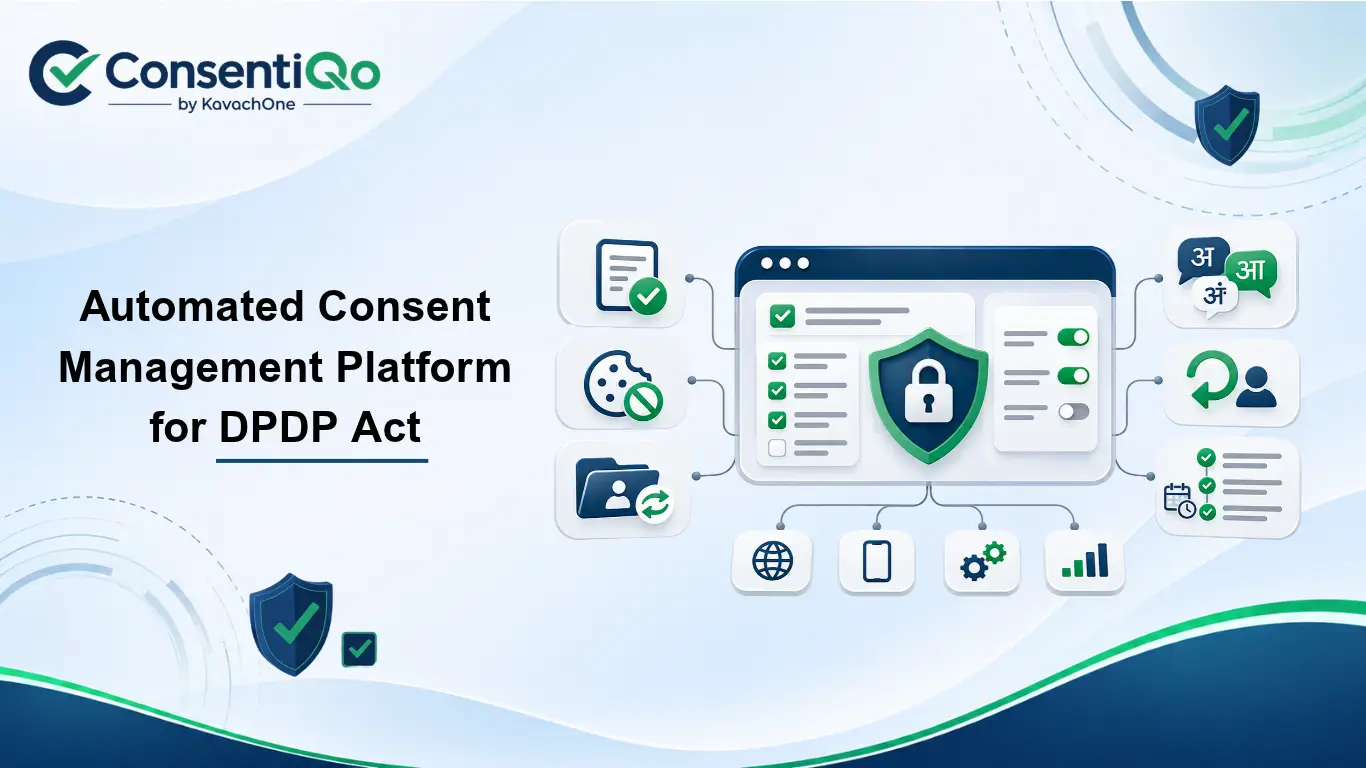
Automated Consent Management Platform for DPDP Act: Complete Compliance Guide
Looking for an automated consent management platform for DPDP Act compliance? ConsentiQo automates purpose-first notices, DSARs, and 7-year audit logs.